
Why the Burden of Proof Is on LRC, Not Us
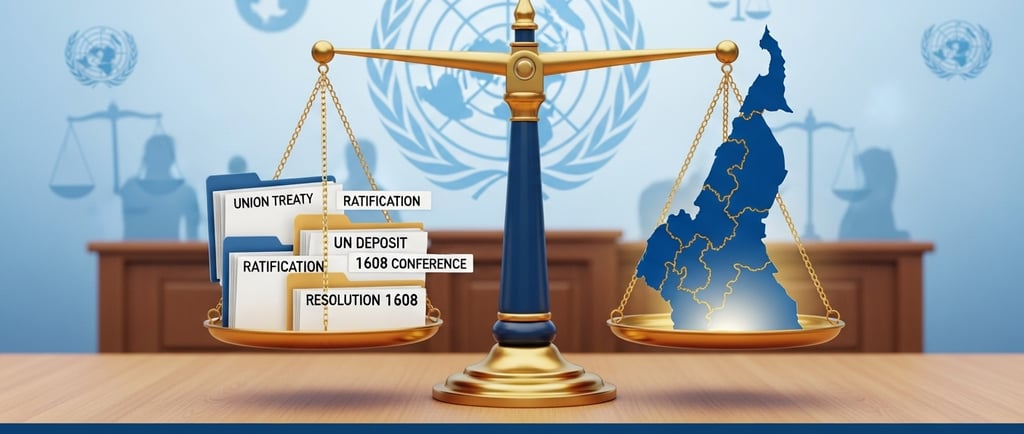
One of the most important lessons our people must learn is this: Southern Cameroonians are not the ones making a claim. La République du Cameroun is the one claiming jurisdiction over our territory. Therefore, the burden of proof belongs entirely to them.
Roland Fru
11/24/20253 min read
This is not politics.
This is basic legal reasoning recognized everywhere in the world.
If LRC claims there was a legal union, then they must provide the legal evidence of that union. If they fail to provide that evidence, the entire claim collapses.
1. We Are Not Claiming LRC. LRC Is Claiming Us
This changes everything.
We are not demanding LRC territory.
We are not demanding LRC citizenship.
We are not claiming to be a province of LRC.
LRC is the one saying:
“You became part of us in 1961.”
If they make that claim, they must prove it.
And proof means:
the treaty of union
the ratification by both parties
the deposit at the UN under Article 102
the administrative authority transfer
the completed Resolution 1608 conference
If these documents exist, we are legally one country.
If they do not exist, no union ever took place.
There is no emotion here.
Only law.
2. If a Union Exists, Southern Cameroons Is a Co-Founder, Not a Region
This is where LRC destroys its own argument.
If they insist a union existed, then Southern Cameroons is not a region, not a minority, and not a subordinate population. We would be one of the two founding partners of the country.
This would mean:
we have equal constitutional power
equal sovereign authority
equal legal standing
equal rights to determine the structure of the state
Not a province.
Not an extension.
A co-founder.
LRC cannot claim a union while treating Southern Cameroons as a plantation.
You cannot be a co-owner and a subordinate at the same time.
3. If a Federation Existed, It Cannot Be Dissolved Without Our Consent
LRC often says:
“We were a federation before 1972.”
This creates an even bigger legal trap for them.
No union or federation on earth can be dissolved by one partner without the consent of the other. Doing so violates:
international law
contract law
state formation principles
UN decolonization rules
constitutional norms
If LRC claims the federation was real, then:
Southern Cameroons has equal power to rewrite the constitution
equal power to restructure the nation
equal power to alter the legal framework
equal power to make national decisions
This applies everywhere in the country, including Yaoundé and Douala.
You cannot dissolve a partnership alone.
It is illegal.
If the federation were real, Southern Cameroons could legally walk into Yaoundé and demand constitutional restructuring as a co-owner of the state.
LRC cannot escape this logic.
4. Either Way, LRC Loses the Argument
There are only two possible outcomes.
Option A: No Treaty Exists
Then:
no union
no federation
no jurisdiction
illegal administrative extension
the trusteeship remains incomplete
UK and UN must finalize the process
Southern Cameroons stands as a trust territory waiting for completion of decolonization.
Option B: A Treaty Exists
Then:
Southern Cameroons is an equal founding partner
the 1972 dissolution is illegal
the 1984 name restoration breaks the union
Southern Cameroons maintains sovereign equality
Southern Cameroons can initiate constitutional change
Either way, LRC cannot claim one sided authority.
Both outcomes destroy their argument.
5. We Do Not Have the Burden of Proving What Does Not Exist
This is the biggest mistake many activists make. You cannot prove a negative. It is impossible and unnecessary.
We do not need to prove:
we are not Cameroonians
we did not sign a treaty
we did not ratify
we did not join
The law is simple.
The party making the claim must provide the evidence.
LRC claims:
“You became part of us.”
So they must show the papers:
the treaty
the signatures
the ratification
the UN deposit
the administrative transfer
the completion of Resolution 1608
They cannot show any of these documents because none exist.
That is why their claim collapses.
6. International Law Is On Our Side
Under the UN system, when a state claims jurisdiction over a trust territory, it must present:
the legal instrument
the UN authorization
the administrative transfer
the treaty of union
LRC has none.
Because:
no treaty was ever signed
no ratification ever happened
no deposition was ever made at the UN
no tripartite conference ever occurred
no authority was ever transferred
Which means:
LRC has no legal basis for jurisdiction in Southern Cameroons.
7. A Clean Statement You Can Use Anywhere
Here is the core truth in one sentence:
We are not claiming LRC; LRC is claiming us. The burden of proof lies entirely on the state asserting jurisdiction, not on the people whose territory is being claimed.
Short.
Accurate.
Irrefutable.
8. A Diplomatic Version for International Engagement
“The legal burden lies on the state asserting jurisdiction. La République du Cameroun must present the treaty, the UN authorization, and the completed decolonization process. Their inability to produce these documents confirms the illegality of their administrative extension.”
This is the language diplomats understand.
9. A Simple Version for Ordinary People
“We are not claiming Cameroon. Cameroon is claiming us. So Cameroon must show the papers. They have none.”
Clear.
Understandable.
Unbreakable.
10. The Message Our People Must Start Teaching
“If there is no treaty, there is no union. If there is a treaty, then we are equal partners with equal national power. Either way, LRC cannot treat us as a subordinate territory. The burden of proof is on them, not on us.”
This is the argument the world respects.
This is the argument the UN understands.
This is the argument LRC cannot escape.
Contact
Reach out for research inquiries or collaborations.
Phone
+1 (281) 315-9387
© 2025. All rights reserved.

