
Why Southern Cameroons Is One of the Rarest Incomplete Decolonization Cases in the World
Across Africa and across the world, most struggles today are internal political conflicts. People fight over elections, marginalization, broken systems, or ethnic tensions inside a legally recognized country. That is not our situation. Southern Cameroons falls into a very small group of territories where the United Nations began a decolonization process but the final legal step was never completed.
11/23/20252 min read
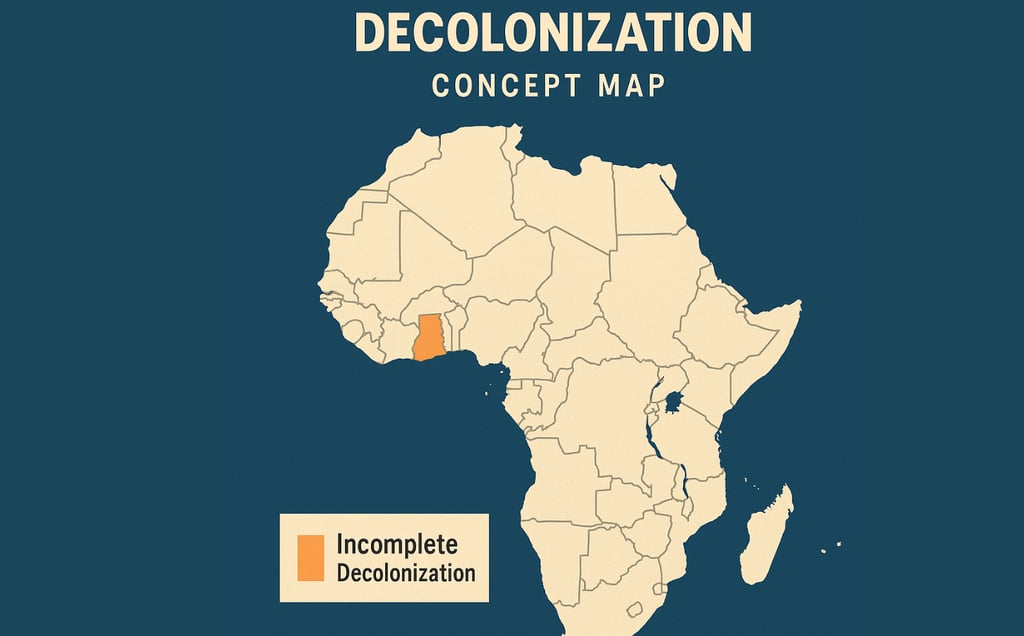
This is what makes our case different, rare, and extremely strong in international law.
We Are Not the Only Case, But We Are the Most Clear Cut
Only a few places on earth still have unresolved decolonization:
Western Sahara
New Caledonia
A few Pacific island territories
Southern Cameroons
Even inside this group, Southern Cameroons stands apart because we had something the others did not have: a complete democratic government that the UN recognized.
We had:
an elected Parliament
a Prime Minister
a working judiciary
internal sovereignty
defined borders
international recognition as a UN Trust Territory
This means we were already a separate political entity, not a province of another country.
The UN Approved Our Independence Through a Treaty That Was Never Signed
In April 1961, the United Nations passed Resolution 1608. It stated clearly that the future of Southern Cameroons had to be finalized through:
Negotiations between Britain, Southern Cameroons, and La République du Cameroun.
Signature of a treaty of union.
Ratification and deposition of that treaty at the UN.
A treaty was not optional. It was the condition for independence.
Here is the truth most people avoid:
The treaty was never signed.
The treaty was never ratified.
The treaty was never deposited.
In simple terms:
The legal union never began.
Britain Left Administratively, Not Legally
Britain withdrew its officials on 1 October 1961, but it did not complete the legal transfer of sovereignty required by UN rules. Nothing was handed over. They just left.
This created what international law calls a void in sovereignty. A territory was left with a functioning government and UN recognition, but with no final legal status. Southern Cameroons ended up suspended between two poles. Not fully independent, but also not legitimately joined to any state.
La République du Cameroun Moved In Unilaterally
Instead of waiting for a signed treaty, La République du Cameroun, which had been an independent country since 1960, simply extended its administration into Southern Cameroons.
There was no UN approval.
There was no legal process.
There was no constitutional act.
There was no consent from Southern Cameroons.
This violated:
Article 76(b) of the UN Charter
The law of treaties
The principle of territorial integrity
The rules guiding the Trusteeship system
The right to self-determination
It is similar to what Morocco did in Western Sahara and what Indonesia tried to do in East Timor. The difference is that Southern Cameroons already had the democratic leadership required to sign a treaty, and that leadership never signed anything.
So Are We the Only Case in the World? No. But We Are the Most Legally Distinct.
Here is the simplest way to summarize it:
We are not the only incomplete decolonization case in the world.
We are the only African territory where a UN approved union was never completed with a treaty.
That makes our case unique in international law.
This is not secession.
This is not rebellion.
This is not dissatisfaction with a government.
It is an unfinished legal process.
It is a missing treaty.
It is another country exercising powers it does not have.
What This Means for Our People
We are not fighting to separate from anything.
We cannot separate from something we never legally joined.
Our job is clear:
Complete the decolonization.
Finish the process.
Restore the legal truth.
This is not a story of emotion.
It is a story of procedure.
And the law is on our side.
Contact
Reach out for research inquiries or collaborations.
Phone
+1 (281) 315-9387
© 2025. All rights reserved.

