
“Occupation” vs “Extension of Administration”
Which Term Is Stronger for Our Case? Most people use the word “occupation” when discussing Southern Cameroons. It feels accurate, but legally it places the burden on you. You must prove an invasion, a military takeover, or a forceful seizure of territory. There is a far stronger and more precise term that shifts the burden entirely onto La République du Cameroun.
Roland Fru
11/24/20252 min read
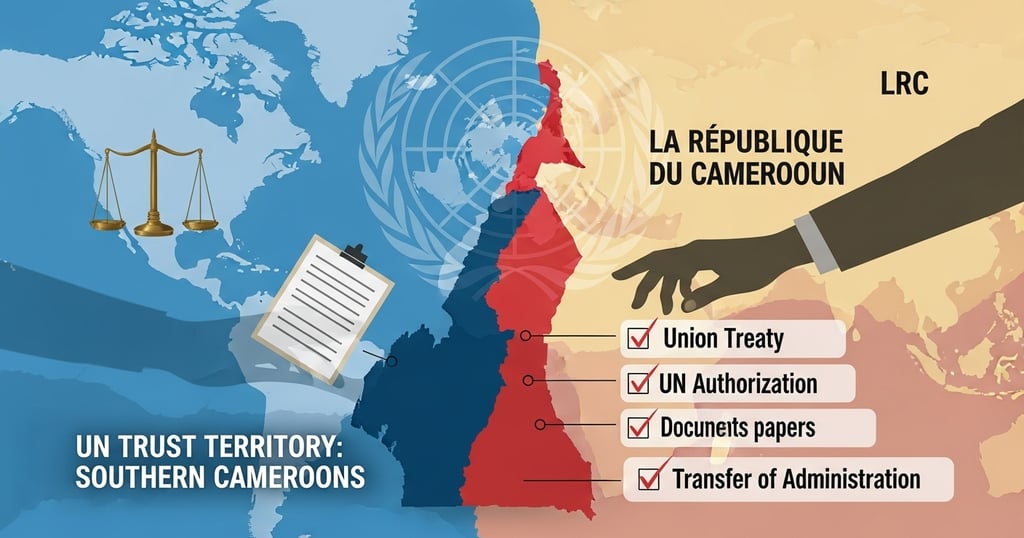
The unlawful extension of La République du Cameroun’s administration into a UN Trust Territory.
This sentence forces LRC to explain how they acquired a power they were never given. And that is why it is the superior framing.
1. Why “Extension of Administration” Is Legally More Powerful
Under international law, only two authorities could legally extend or modify administration over Southern Cameroons.
The United Kingdom, the Administering Authority
The United Nations, the Supervising Authority
No other entity had the right to transfer, expand, or rearrange authority within a UN Trust Territory.
This means LRC must answer the following questions.
Who gave them administrative authority
When the authority was transferred
Where the document authorizing it is
Which treaty empowered them
Which UN resolution approved it
How they claim jurisdiction over the territory
They cannot answer any of these questions, because none of the required steps ever happened.
This is why your framing is correct. It puts the responsibility on LRC to justify a power they illegally assumed.
2. “Extension of Administration” Matches UN Language Perfectly
The United Nations does not use the word “occupation” when discussing Trusteeship Territories. The UN system is built around technical categories.
Administration
Jurisdiction
Authority
Mandates
Trusteeship responsibilities
Legal transfers of power
Every one of these requires signed documents and recorded authorization.
When you say:
“La République du Cameroun extended its administration into a territory without UN approval and without a treaty,”
you are speaking the exact language that the UN and international courts understand.
At that moment, LRC is cornered. They now carry the burden of proving authority in a system where authority must always be documented.
And they have no documentation.
3. Does Adom Getachew’s Framework Support This Argument?
Absolutely. In Worldmaking After Empire, Adom Getachew focuses on how the end of empire left Africa with incomplete transfers of power.
She shows that many postcolonial states inherited:
unfinished decolonization
legal vacuums
administrative gaps
and unclear transitions from empire to independence
Her central claim is simple. When decolonization is incomplete, postcolonial states often expand their administration into areas where they have no legitimate authority, imitating the same empire they replaced.
This is exactly what happened to Southern Cameroons.
Britain did not complete the transition.
The UN process stopped halfway.
Resolution 1608 was never carried out.
No treaty was ever signed.
LRC stepped into the vacuum by extending its administration into a territory still under UN supervision.
Getachew’s work describes this dynamic perfectly.
4. How Her Argument Supports the Southern Cameroons Case
Getachew explains that most African states inherited:
borders they did not design
territories they did not negotiate
administrative structures imposed by colonizers
and incomplete political transitions
Southern Cameroons is a textbook example.
We were a UN trust territory with international oversight. Britain left without completing the final legal act. LRC moved in not through treaty, not through negotiation, not through UN authorization, but through simple administrative expansion.
Getachew’s critique shows that this is not rebellion on our part. It is a case of unfinished decolonization and unlawful administrative extension by a neighboring state.
Her framework makes our argument stronger and more understandable to academics, diplomats, and international lawyers.
5. The Message Our People Must Understand
If you call it “occupation,” you must prove that LRC invaded illegally. That is a heavy burden.
If you call it “extension of administration,” the burden shifts instantly.
Now LRC must prove they ever had the right to be here in the first place.
This is not emotional language.
This is not political language.
This is administrative law.
This is trusteeship logic.
This is UN procedure.
This is the exact area where LRC has no evidence at all.
And that is why “extension of administration” is the strongest, most accurate framing of our situation.
Contact
Reach out for research inquiries or collaborations.
Phone
+1 (281) 315-9387
© 2025. All rights reserved.

